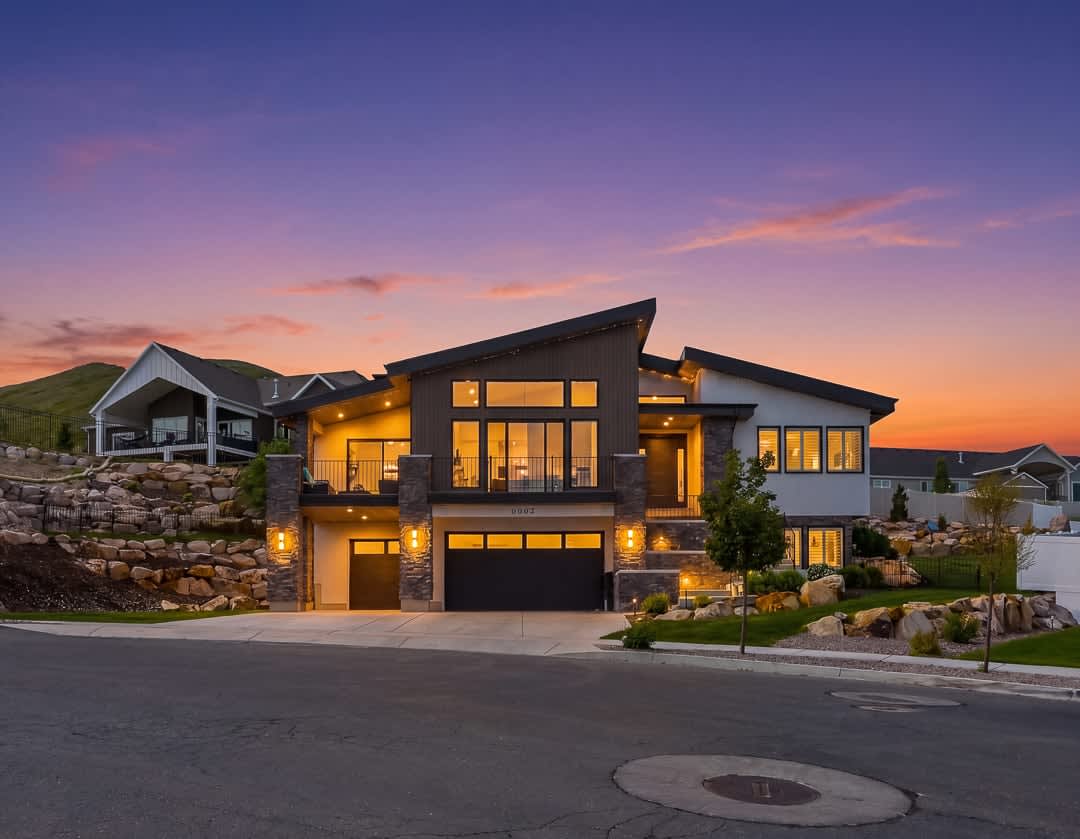
On December 21 the sun over Eagle Mountain never climbs higher than 26 degrees, and a house that faces north gets no direct sun on its front from late September until mid-March. That decides more about winter real estate photos in Utah than any editing trick. Book the shoot around where the sun actually is, pick the day around the weather, and most winter listings photograph fine.
Below: the low sun, snow, and inversion haze, with what goes wrong and what to do about each.
How low is the winter sun in Utah County?
Low enough that the clock matters more than it does in July. The table below is computed for Eagle Mountain from NOAA's published solar equations. Times are Mountain Standard Time and assume a flat horizon, so a home tucked under the Wasatch foothills loses direct light earlier than the table shows.
| Date | Sunrise | Sunset | Daylight | Sun at least 10° up | Noon sun height | Shadow at noon |
|---|---|---|---|---|---|---|
| Nov 15 | 7:14 am | 5:10 pm | 9 h 56 m | 8:20 am – 4:05 pm | 31° | 1.7 × object height |
| Dec 21 | 7:47 am | 5:04 pm | 9 h 17 m | 9:00 am – 3:50 pm | 26° | 2.0 × |
| Jan 15 | 7:49 am | 5:26 pm | 9 h 37 m | 9:00 am – 4:15 pm | 29° | 1.8 × |
| Feb 15 | 7:21 am | 6:03 pm | 10 h 41 m | 8:25 am – 5:00 pm | 37° | 1.3 × |
| Jun 21 (for contrast) | 5:58 am | 9:01 pm | 15 h 02 m | 73° | 0.3 × |
Two numbers do most of the damage. In late December, sun high enough to clear a fence line and a neighbor's roof runs from about 9:00 to 3:50, under seven hours. And at noon on the solstice, a 30-foot spruce in the front yard throws a shadow about 60 feet long, enough to cross a shallow front yard and climb the porch.
Which side of the day to book, by the way the front faces
Book by orientation. All winter the sun rises in the southeast, stays in the southern sky and sets in the southwest, so each side of a house gets a predictable slice of it.
- South-facing front. Lit all day. Book late morning to early afternoon, when the sun is highest and the shadows are shortest. Watch for long tree and neighbor shadows across the driveway.
- East-facing front. Direct sun only until about 12:25 in December. Book between roughly 9:30 and noon.
- West-facing front. Direct sun from about 12:30. Book from 1:00 until about 3:30 in December, or 4:30 by mid-February.
- North-facing front. No direct sun at any hour from about September 24 to March 19. The front sits in open shade all day, which is even and soft but flat and a little blue.
North-facing homes are the hard case. Waiting doesn't help, because better light won't come until spring. The options are to shoot the front in even light on a clear day, lead the listing with the sunlit backyard or a south-side angle, and use a dusk exterior. A virtual twilight conversion turns the daytime front into a lit-windows dusk shot for $25 a photo, and the Professional package includes one.
Snow: shoot the first clear day after the storm
Fresh snow photographs well for a short window. Then it gets plowed into gray berms, tracked across the lawn and melted into patchy brown, and it starts to look like a maintenance problem rather than a season.
So the timing rule is simple. Book the first clear day after a storm, not the third.
Prep for a snow day is mostly about edges:
- Clear the driveway and walks to the concrete, edge to edge. A half-shoveled path reads as neglect in a wide shot.
- Knock down icicles over the entry and sweep the porch and steps.
- Move the plow berm off the curb in front of the house if you can. It's the first thing in the street-view frame.
- Hide the shovels, salt bags and boot trays from the entry and garage shots.
- Turn the heat up an hour early. Cold glass fogs and frosts, and a frosted window blocks the light that makes the interior work.
Inversion: why a clear forecast can still give you gray
An inversion is cold air trapped under warmer air, with the surrounding mountains holding it in place. Pollution builds under that lid, along with a flat, milky haze that hides mountain views and turns blue skies white.
Snow makes it more likely. NASA's Earth Observatory reports research estimating that the chance of fine-particle pollution exceeding national standards in the Salt Lake area rises from about 5 percent with no snow on the ground to 22 percent with snow. The Central Wasatch Commission notes that a passing storm is usually what clears it out.
That gives a useful pattern for scheduling. The cleanest air often comes right after a storm, and haze tends to build through a cold, still spell until the next one. For a listing that sells on a view of Timpanogos, Utah Lake or the Oquirrhs, that window matters. Check the Utah Division of Air Quality's county forecasts before you confirm, and move the exterior and aerial shots if the valley is socked in. Interiors can still go ahead that day.
Holiday decor dates the listing
Pull it before the shoot. A wreath is harmless; a lit tree in the living room is not. If the listing is still active in February, December decor tells every buyer how long it has been sitting, and those photos will be on the MLS for as long as the listing is.
Can you use summer exteriors on a winter listing?
Yes, if they're labeled. Buyers browsing in January want to know what's under the snow, and sellers often have spring or summer shots of the yard. The NAR Code of Ethics asks Realtors to "present a true picture in their advertising," so caption them with the season, keep them after the current exteriors, and make sure nothing has changed since they were taken. Check with your broker if you aren't sure how your brokerage handles it.
If the listing might run into spring, plan for that too. Utah Realty Photos galleries stay up for 45 days, and a 60-day extension costs $49, so download the full set before it expires.
What a good winter set looks like
Run the gallery against this list before it goes live:
- The front exterior is either in direct sun or deliberately in even light, not half in shadow.
- Driveway and walks show clean concrete.
- The sky is blue or a believable dusk, not white haze.
- Windows aren't fogged or frosted.
- There's no holiday decor inside, and nothing seasonal outside that will look stale in six weeks.
- Any warm-season photos carry a caption saying when they were taken.
A north-facing front will often be the weakest photo in the set. Lead with something else. Prices for every add-on are on the pricing page, and the cost guide compares them with other Utah providers.
Book the slot that matches the way your listing faces. Morning for east, afternoon for west, midday for south, and any clear day plus a twilight for north.
Researched and drafted with AI assistance; reviewed and edited by Thomas.
Frequently asked questions
What time of day is best for winter listing photos in Utah?
It depends on the way the front faces. In December, east-facing homes get direct sun until about 12:25, west-facing homes from about 12:30, and south-facing homes all day. North-facing fronts get no direct sun from late September to mid-March.
Does inversion affect real estate photos?
It can. Inversion haze flattens the light and hides mountain views. It's more likely when snow is on the ground, and a passing storm usually clears it. Check the Utah Division of Air Quality forecast before booking exteriors or drone.
How do you photograph a north-facing house in winter?
Shoot the front in even light on a clear day, lead the listing with a sunlit side or the backyard, and add a virtual twilight of the front, which costs $25 per photo at Utah Realty Photos.
Sources
- NOAA Global Monitoring Laboratory: Solar Calculator
- NOAA Global Monitoring Laboratory: Solar Calculation Details
- NASA Earth Observatory: Snow and Haze in Utah
- Central Wasatch Commission: Wintertime Inversion Explained
- Utah Division of Air Quality: Current conditions and forecasts
- National Association of Realtors: Case interpretations related to Article 12
- Utah Realty Photos: Pricing